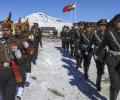
Opposition parties on Tuesday questioned the "silence" of Prime Minister Narendra Modi and Defence Minister Rajnath Singh on the violent clash between Indian and Chinese troops in eastern Ladakh and asked them to take the nation into confidence on the matter, while the ruling Bharatiya Janata Party asserted that India's borders will remain intact under Modi's leadership.

'The immediate attempt by China is to get its way and gain territory through small steps without having a full-scale war.'

'This is potentially escalatory, as China does not believe that India has any basis for interfering in a bilateral dispute between China and one of its neighbours.'

'Why wouldn't so strategically-minded an adversary, such as China, not militarily exploit to the maximum Indian timidity, stupidity, and cupidity all along the LAC and legitimate, as it has done so often in the past, the fait accompli of incremental territorial grabs which, by the way, is its strategy and policy as implemented on the ground?'
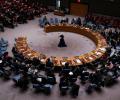
India abstained from a procedural vote taken in the United Nations Security Council to call for a rare special emergency session of the UN General Assembly on Russia's aggression against Ukraine, even as New Delhi welcomed Moscow and Kyiv's decision to hold talks at the Belarus border.

The Chinese aren't after territory. Their target is our national will, morale and the sense of autonomy we feel in making our strategic choices. They are attacking India and the Modi government at their weakest point, asserts Shekhar Gupta.

'The border stand-off and the uncertainties that come with it should be a wake-up call on what makes for real rather than illusory power,' observes T N Ninan.

Under the India-China agreement on the disengagement process in eastern Ladakh, the Chinese army will pull back its troops to east of Finger 8 areas in the northern bank of Pangong lake, Defence Minister Rajnath Singh said in Parliament on Thursday, in what is seen as a significant step to dial down tensions in the key face-off site.

From the standoff with China to the government's response to the farmers' protest, Defence Minister Rajnath Singh holds a freewheeling talk.

'One must remember that a dragon has a forked tongue,' warns Vivek Gumaste.

While OnePlus 8 and 8 Pro were launched in April, the devices were not brought into the Indian market given the lockdown.

'If you behave like a nail, the adversary will behave like a hammer.'

India is committed to finding an 'early settlement' to the vexed boundary issue: Swaraj
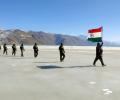
'India's challenge is status quo ante. China's challenge is a face-saving exit'

'It is because of the bravery of Colonel Santosh Babu and his men that we have not seen a violent escalation anywhere else along the LAC.'

Indians at large harbour a notion that their country is cherrypicking out of the American basket of goodies, but the policymakers in Delhi and the political leadership are well aware that it can only be a pipe dream since a military alliance with a superpower is a profound irrevocable commitment, observes Ambassador M K Bhadrakumar.

'There will be some issues of contention, especially on H1B visa and on trade policy.'

'The adversary will always exploit India's anti-national elements.'
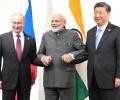
For the first time since the standoff between Indian and Chinese troops along the Line of Actual Control (LAC) in eastern Ladakh, Prime Minister Narendra Modi and Chinese President Xi Jinping are expected to come face-to-face virtually at the BRICS (Brazil-Russia-India-China-South Africa) annual summit to be held on November 17.
'They cannot use firearms.' 'They have to be restrained.' 'It is a game of patience and chess board moves.' 'It is not like India and Pakistan where bullets get fired and people get killed.'

We strongly urge India to take practical steps to correct its mistake, Wu said.

Modi, who is undertaking his first visit to China as prime minister, will reach the ancient city of Xi'an, the home town of President Xi Jinping, for a summit meeting, an unusual departure from normal protocol and seen as a reciprocal gesture by the Chinese leader who was hosted by Modi in Ahmedabad when he visited India in September last year.
'We will not accept these misadventures by the Chinese.'

There is no conceivable reason for any big power to put road blocks on the path of an India-Pakistan normalisation process, asserts Ambassador M K Bhadrakumar.

Narrowing of differences on competing territorial claims along the un-demarcated LAC might take weeks, if not months, of hard-nosed negotiations. Without some give and take on both sides, the impasse will be hard to resolve, observes Virendra Kapoor.

Samdong Rimpoche's visit to China materialised against the backdrop of strained India-China relations consequent to the face-off between Indian and Chinese troops at Doklam, says former RAW officer Jayadeva Ranade.

'Both have a very nationalistic view of foreign policy.' 'They think they are shrewd and clever diplomats.'

The J-20 fighter is called Beijing's answer to the US F-22 stealth fighter and the F-35 that will be soon deployed in the Pacific by the United States and Japan.
'China is mindful of the fact that it is not confronting the Indian Army of 1962. But the sabre rattling will continue.'

The Border Defence Cooperation Agreement with China needs closer scrutiny, says Rup Narayan Das.

Indian and Chinese militaries have agreed on the need to expand cooperation and identify new avenues of engagement, government said on Thursday.

Arpi deserves to be complimented for the commitment and hard work that have gone into this production. The frustrations of seeking reliable documentation from the catacombs of the Indian bureaucracy did not deter him from going after the best information available, and the result is one that he can take much satisfaction in. Ambassador Prabhat P Shukla, Member Advisory Council, Vivekananda International Foundation, reviews Claude Arpi's The End of an Era: India Exits Tibet.

'India in 2020 is a lot better prepared than in 1962.' 'It is no longer a pushover; and anything other than a crushing Chinese military victory will be a major loss of face for China,' observes Rajeev Srinivasan in the first of a three part column.

'Once positions are hardened and troops start building defences, it is difficult for soldiers to step back.'

Modi's arrival has changed the optics of the visit. There is a different demonstration of the confidence level in the Indian leadership, but not much has changed beyond that, reports Sheela Bhatt/Rediff.com.

The focus of the talks will be to ensure mutual development and expanding overall ties, diplomatic sources said.

'The missile mounted near Kailash-Mansarovar is called DF-21. It is a medium-range, 2,200 kilometres ballistic missile. Its advantage is that it can cover all cities of north India, including New Delhi'

President Xi Jinping's visit may put relations between India and China on a new trajectory

India said a new mechanism will be set up for issues relating to trade and investment.
'We should not worry too much about Indian capabilities, both military and otherwise.'
